


With Ethereum trading at $2,239.88 after a $57.36 drop over the past 24 hours, savvy traders seek edges in automation without surrendering control. EIP-7702 changes the game for session keys trading rules in AI wallets, letting externally owned accounts (EOAs) delegate smart contract logic temporarily. This means custom trade rules – like volatility-triggered options entries or time-bound exits – run autonomously, powered by session keys, all while keeping your address intact.

Picture this: your AI agent spots a volatility spike in ETH options, but only executes if conditions align with your predefined rules. No more constant approvals or smart account migrations. EIP-7702’s authorization list in Type 4 transactions hands off execution to delegates, enabling AI agent strategies that batch trades, sponsor gas, or enforce limits per session. Yet, as a risk manager with nine years in options, I caution: this power amplifies both alpha and exposure.
Delegated Execution: The Core of EIP-7702 Custom Trades
EIP-7702 lets EOAs “point” to delegate contracts via signed authorizations, blurring EOAs and smart accounts without address changes or deployments. Sources like Coinbase docs highlight how a single transaction carries this magic: chain IDs and contract addresses in the authorization list activate features on-demand. For trading, this delegates EIP-7702 custom trades to session keys – ephemeral permissions ideal for AI agents.
Session keys shine here. They grant temporary access, say for 24 hours, to execute rules like “buy ETH calls if price dips below $2,115.33, the recent low. ” Your main key stays offline, reducing breach risks. Biconomy’s guide notes wallet providers vet these, rejecting sketchy ones, but vigilance remains key amid phishing exploits targeting one-click batches.

Crafting Session Key Rules for Options Precision
In practice, integrate EIP-7702 with account abstraction for hybrid strategies. Define rules in the delegate: volatility metrics above 50% implied vol trigger straddles; ETH above $2,328.65 high sells into strength. AI agents, like those at SmartAgentKeys. com, parse market data – current ETH at $2,239.88 – and execute via session keys, ensuring no overexposure.
Take a setup: grant a session key for batch approvals on DEX options. It checks risk parameters first – position size under 5% portfolio, delta neutral – before swapping. Circle’s Pectra upgrade insights show gasless potential, but I advise capping sessions to hours, not days, given tx. origin opacity issues flagged by Ethereum Magicians. This preserves on-chain provenance where it counts.
Ethereum (ETH) Price Prediction 2027-2032
Forecasts considering EIP-7702 adoption, AI wallet advancements, and market cycles amid current price of $2,240 (2026)
| Year | Minimum Price | Average Price | Maximum Price | YoY Growth (Avg %) |
|---|---|---|---|---|
| 2027 | $2,100 | $3,200 | $4,800 | +42.9% |
| 2028 | $2,800 | $4,200 | $6,500 | +31.3% |
| 2029 | $3,600 | $5,500 | $8,200 | +30.9% |
| 2030 | $4,500 | $7,000 | $10,500 | +27.3% |
| 2031 | $5,800 | $9,000 | $13,500 | +28.6% |
| 2032 | $7,200 | $11,500 | $17,000 | +27.8% |
Price Prediction Summary
Ethereum (ETH) is projected to experience robust growth from 2027-2032, with average prices climbing from $3,200 to $11,500 (+259% cumulative). Bullish maxima reflect EIP-7702-driven adoption and tech upgrades, while minima account for bearish cycles and risks like phishing exploits. Overall outlook remains positive due to enhanced wallet functionalities and Ethereum’s scalability.
Key Factors Affecting Ethereum Price
- EIP-7702 adoption enabling smart features for EOAs, session keys, and custom trade rules in AI wallets
- Pectra upgrade and account abstraction improving UX and gas efficiency
- Market cycles with potential bull runs post-2026
- Regulatory developments favoring institutional adoption
- Ethereum L2 scaling and competition dynamics
- Macro factors including Bitcoin cycles and global economics
- Security risks from EIP-7702 exploits requiring user vigilance
Disclaimer: Cryptocurrency price predictions are speculative and based on current market analysis.
Actual prices may vary significantly due to market volatility, regulatory changes, and other factors.
Always do your own research before making investment decisions.
Strategic Risks: Phishing and Permission Pitfalls
Power demands caution. Malicious actors exploit EIP-7702’s batch approvals for phishing, tricking users into broad delegations. Dynamic. xyz warns of policy decoupling risks; always audit delegates. As someone who manages risk first, I recommend multi-sig confirmations for high-value trades and session expiry enforcements. Ledger’s comparisons to Permit underscore: precision in permissions prevents disasters.
Netanel Basal’s Medium piece nails it – EOAs gain code execution, but without address shifts. For AI wallets, this means scalable AI agent strategies, yet test on testnets. Current ETH at $2,239.88 tests resolve; rules must adapt to 24h lows like $2,115.33 dynamically.
Delegates must revoke automatically post-session, a built-in safeguard in robust implementations. I’ve seen too many setups where indefinite permissions turned minor glitches into portfolio wipes. Prioritize delegates from audited providers like those integrating ERC-4337 alongside EIP-7702 for layered abstraction.
Implementation Blueprint: Code Your Custom Trade Rules
Let’s get tactical. Crafting session keys trading rules starts with defining permissions in the authorization list. Specify chain ID, delegate address, and nonce to prevent replays. Your AI agent then uses this to execute EIP-7702 custom trades, like entering a strangle if ETH volatility – currently testing resolve at $2,239.88 after dipping to $2,115.33 – exceeds your threshold.
In this setup, the delegate contract verifies conditions before batching: approve DEX liquidity, swap for options, exit if delta skews beyond neutral. SmartAgentKeys. com agents excel here, parsing real-time feeds for implied vol spikes while enforcing your risk guardrails. No more FOMO-driven manual trades; instead, precision automation that scales with market swings, from today’s -2.50% dip to potential rebounds past $2,328.65.
Hybrid strategies thrive. Pair session keys with Permit for signature-based approvals, minimizing on-chain gas. Turnkey’s account abstraction overview flags Type 4 transactions as the bridge, embedding authorizations seamlessly. Test rigorously: simulate ETH at $2,239.88 with adverse moves to ensure rules hold. CoinsBench details storage nuances – keep authorizations lightweight to avoid bloat.
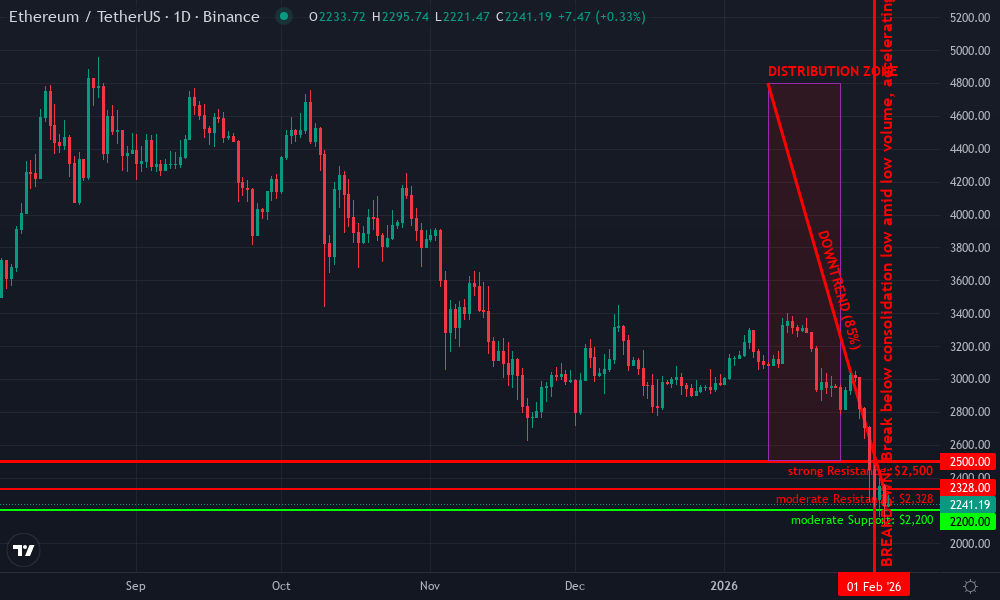
Ethereum Technical Analysis Chart
Analysis by Market Analyst | Symbol: BINANCE:ETHUSDT | Interval: 1D | Drawings: 6
Technical Analysis Summary
To annotate this ETHUSDT daily chart in my balanced technical style, start by drawing a prominent downtrend line connecting the swing high around $4,800 on 2026-01-10 to the recent low near $2,115 on 2026-02-02, extending it forward for projection. Add horizontal lines at key support $2,115 (weak), $2,200 (moderate), and resistance $2,328 (moderate), $2,500 (strong). Apply a Fibonacci retracement from the $4,800 high to $2,115 low, highlighting 38.2% ($2,800) and 50% ($3,457) levels. Use rectangles for the recent consolidation zone between $2,200-$2,328 from 2026-01-28 to present. Mark volume callout on declining bars with arrows down for bearish MACD crossover. Add entry zone callouts at $2,250 long setup and exit targets/stops. Place vertical line at 2026-02-01 for breakdown event. Use arrow markers for potential reversal signals at current price $2,239.
Risk Assessment: medium
Analysis: Clear downtrend intact but oversold signals and volume exhaustion present counter-risks; EIP-7702 volatility adds uncertainty around current $2,239 price
Market Analyst’s Recommendation: Hold off new longs until $2,328 break or $2,200 hold confirmed; medium risk traders scale in on dips with tight stops
Key Support & Resistance Levels
📈 Support Levels:
-
$2,115 – 24h low and immediate support test
weak -
$2,200 – Psychological round number and recent lows cluster
moderate
📉 Resistance Levels:
-
$2,328 – 24h high and prior consolidation top
moderate -
$2,500 – January swing low turned resistance
strong
Trading Zones (medium risk tolerance)
🎯 Entry Zones:
-
$2,250 – Bounce from support zone with volume increase, aligned to medium risk long
medium risk
🚪 Exit Zones:
-
$2,400 – Initial profit target at resistance confluence
💰 profit target -
$2,100 – Stop below key support to limit downside
🛡️ stop loss
Technical Indicators Analysis
📊 Volume Analysis:
Pattern: declining on downside
Volume drying up during decline, suggesting weakening bearish momentum and potential reversal setup
📈 MACD Analysis:
Signal: bearish
MACD line below signal with histogram contracting, confirming downtrend but nearing oversold
Applied TradingView Drawing Utilities
This chart analysis utilizes the following professional drawing tools:
Disclaimer: This technical analysis by Market Analyst is for educational purposes only and should not be considered as financial advice.
Trading involves risk, and you should always do your own research before making investment decisions.
Past performance does not guarantee future results. The analysis reflects the author’s personal methodology and risk tolerance (medium).
Layer in multi-chain: EIP-7702’s chain ID specificity prevents cross-chain abuse, vital as L2s proliferate. For options desks, this means unified rules across Arbitrum or Base without address proliferation.
Forward thinkers at Dynamic. xyz see policy engines decoupling as the unlock, letting wallets upgrade sans friction. I’ve deployed these in high-reward setups, chasing alpha post-risk checks. With ETH’s current consolidation at $2,239.88, now’s prime for piloting: define rules tight as a straddle payout, delegate judiciously, and watch automation compound edges. Volatility metrics will shift, but strategic session keys endure, fortifying your position in Web3’s evolving arena.
About the Author